

Overview
There is a great deal of demand for skilled labour in Australia, but nowhere near enough supply. The 2023 Skills Priority List shows 36% of occupations were in national shortage (332 out of 916), about 5 percentage points higher than 2022 (31% of occupations). The rise in shortages in 2023 from 2022 reflects the cumulative impacts of recruitment challenges stemming from a persistently tight labour market which began tightening from late 2021.
The Department of Home Affairs is closely considering how to manage the increasing trends of competition, demand, and even artificial intelligence.
Artificial Intelligence in Immigration
The introduction of Artificial Intelligence (AI) GPT-models, such as ChatGPT, has gained popularity from individuals and businesses alike due to the technology’s robust capabilities that save time, resources and money by replacing human input with a automated systems that are capable of performing complex tasks with minimal technical errors. However, these technologies are not new for Governments – in fact, the U.S. and Canada have been at the forefront of incorporating AI and machine learning (ML) technologies in all areas of Government for many years already. For instance, in the immigration sector, the two nations have already implemented automated decision-making systems which approve or reject certain types of Visa applications without the need for any human oversight.
While the Australian Government is already making use of Artificial Intelligence in the immigration sector, they are yet to follow the U.S. and Canada with respect to automated decision-making on Visa applications. It would not be surprising, though, to see the Australian Government soon follow global trends and adopt a similar approach in our Visa decision-making process.
But how would this impact Visa Applicants trying to enter Australia – specifically for the 482 Temporary Skill Shortage (TSS) Visa?
First, let’s examine the current trends surrounding the 482 TSS Visa.
482 TSS Visa – Forecasting Demand and Trends
The below table illustrates the current trends of 482 Visa Applications Lodged vs Granted:

From December 2022 to December 2023, Primary Applications Lodged for 482 Visas increased by 15.4%. However, the Primary Applications Granted decreased by 18%. Furthermore, the Number of Primary 482 Visa Holders in Australia decreased by 17.1%. This indicates that despite a significant growth in the amount of people trying to obtain a 482 Visa, the Australian Government has significantly reduced the amount of approved applications, suggesting that it is becoming increasingly difficult to obtain a 482 Visa under this current trend.
The below chart depicts Primary Visas Granted for the Top 3 Australian and New Zealand Standard Classification of Occupations (ANZSCO) Occupational Groups:
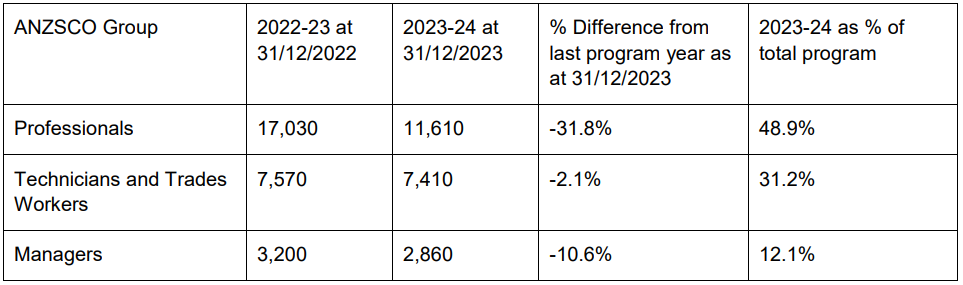
Out of the Top 3 ANZSCO Groups, Professionals (individuals who perform analytical, conceptual and creative tasks) saw the most significant decrease in Granted Applications (-31.8%). Technicians and Trades Workers (individuals who perform a variety of skilled tasks, often in support of scientific, engineering, building and manufacturing activities) were least impacted, reducing by only 2.1% from 2022 to 2023.
The significant decrease in the total number of 482 Visa Applications granted from 2022-23 can be mostly attributed to Professionals and Managers occupations. In turn, this suggests that a growing significance has been emphasised on sourcing highly skilled Technicians and Trades Workers by the Australian Government.
For the purposes of 482 TSS Visa Applicants, Technicians and Trades Workers may include:
- Diesel Mechanics
- Car Detailers
- Panel Beaters
482 TSS Visa – Managing the Increased Demand
The 482 TSS visa enables employers to address labour shortages by bringing in skilled workers where employers cannot source an appropriately skilled Australian worker. It allows applicants to stay, study and work in Australia, and even provides them a pathway to apply for permanent residency, making it one of the most sought after Visas for applicants to apply for.
The current market conditions have made the 482 TSS Visa highly desirable for businesses (sponsors) and applicants alike. Every day, this sector is becoming more competitive as more people are applying, and the Department of Home Affairs is under pressure to ensure only the best skilled labour applicants are granted; and to process the applications more efficiently to fill businesses’ skilled worker shortages faster.
The result will likely be stricter criteria for granting applications (which would also mean more broad reasons they may reject an application), and the implementation of automated decision-making.
With stricter criteria for applicants trying to enter Australia, it means that even the smallest mistakes can lead to an application being rejected. This will be made even more prominent with the potential introduction of AI in the decision making-process, where even minor technical mistakes or omissions will automatically lead to a rejection, costing businesses more time and money for unsuccessful applications.
Prepare Your Business for Change
Decisions made by the Department of Home Affairs can often be sudden and unexpected.
This is a critical juncture for businesses to solidify a plan moving forward. Do not be caught off guard by stricter criteria, the introduction of automated decision-making, or growing levels of competition.